
Before the Deep Freeze: How to Winterize Your Outdoor Taps, Garden Hoses and Hose Reels in Cochrane
When should I winterize outdoor taps?
Do it in the fall, before the first hard freeze, once nights are regularly dropping below zero. Around Cochrane, long cold snaps and chinook freeze-thaw swings are hard on plumbing. Water left in an outdoor tap, or in the pipe behind it, can freeze, split the line, and leak into your home.
What should I take off the tap first?
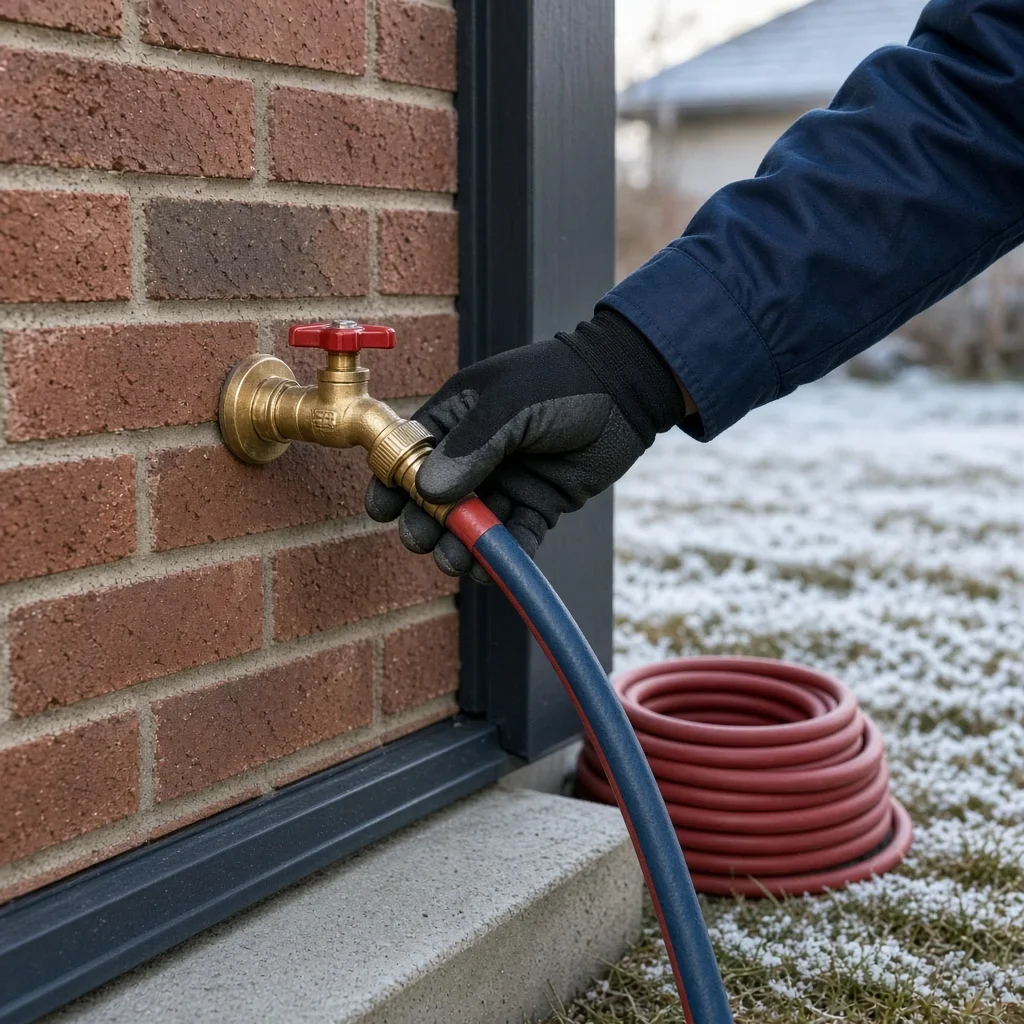
Disconnect every garden hose from every outdoor tap, along with anything else screwed on: splitters, quick-connects, and timers.
A hose left on stops a frost-free tap from draining. Water stays in the tube, freezes, and can split it inside the wall. Tap makers including Woodford, Watts and A.Y. McDonald all say to remove the hose in freezing weather, and the City of Calgary recommends the same.
How do I shut off and drain an outdoor tap?
Most outdoor taps have a second shut-off inside, which the City of Calgary calls a stop and drain valve. It is usually in the furnace or mechanical room, or on the pipe just before it leaves the house.
- Close the indoor valve.
- Go outside and open the outdoor tap so the water can drain out.
- Open the small drain (bleeder) cap on the side of the indoor valve to empty the pipe.
- Once the dripping stops, close the bleeder cap.
- Close the outdoor tap.
EPCOR and other Canadian utilities advise against leaving the outside tap open all winter, because it lets freezing air into the pipe inside the house. If your tap maker gives different instructions, follow those.
No indoor shut-off? Turn the outside tap off, remove everything from it, add an insulated cover, and check the tap and the pipe inside now and then for drips or ice. That is a stopgap; having a plumber add an indoor shut-off or a frost-free tap is strongly recommended.
Frost-free or standard: which tap do I have?
A frost-free (freezeless) sillcock has its handle outside, but the valve actually closes inside the heated part of the house, at the end of a long tube through the wall. When you shut it off, the water in that tube drains out the spout. That only works if the tap slopes slightly downward toward the outside and nothing blocks the spout.
Signs you have one:
- Inside, a long tap body passes through the rim joist or wall and connects to the water pipe in a heated space.
- It drips briefly after you shut it off as it drains. A drip that keeps going means a worn washer or seat.
A standard tap closes right at the outside wall, so the pipe behind it must be shut off and drained from inside. Even with a frost-free tap, closing the indoor valve if you have one is cheap extra protection in our climate.
Should I blow the lines out with compressed air?
For the outdoor taps on your house, generally no. With the hose off, the indoor valve closed and the line drained, gravity does the job.
Compressed-air blowouts are for underground lawn sprinkler systems, where water sits in buried pipe and valves. The City of Calgary lists blowing out irrigation as a separate fall step. Those blowouts use regulated low pressure (Colorado State University Extension cites no more than 50 psi for flexible polyethylene pipe and 80 psi for PVC) through a proper connection after the backflow preventer.
Forcing air backward through an ordinary house tap can damage its seals or push air into your home plumbing. If you have a sprinkler system, have it professionally blown out.
How do I winterize garden hoses and hose reels?
Water left in a hose can freeze and split it or damage its fittings.
- Disconnect the hose from the tap.
- Stretch it out on a slope, or walk it from one end to the other to push the water out.
- Coil it loosely and store it somewhere above freezing, like a garage, shed or basement.
For wall-mounted and retractable reels, turn off the tap and open the nozzle to release pressure. Disconnect the short leader (supply) hose from the tap and from the reel, then unwind, drain and rewind the main hose. Store the reel indoors if you can. The leader hose counts as a hose: left on the tap, it traps water in a frost-free tube just like a garden hose.
Do insulated faucet covers replace draining?
No. A cover adds insulation, but it does not replace removing the hose and draining the line. Covers are still worth having on a tap that is not frost-free, as EPCOR suggests.
What about the vacuum breaker on my tap?
The City of Calgary notes that outside taps have a vacuum breaker or anti-siphon device. It stops hose water from siphoning back into your home and is a code requirement, so leave it in place. A small spurt from it when the tap turns on or off is normal. Some add-on vacuum breakers do not drain on their own and need manual draining before freezing weather, so check the maker's instructions. One that leaks constantly while the tap runs needs repair.
How do I know if a line has already split?
Freeze damage usually happens silently in winter and shows up the first time you use the tap in spring. Woodford explains that because the split is past the shut-off valve, nothing leaks until the tap is opened, sometimes months later.
Watch for water in the basement, wall, ceiling or rim joist area when the outdoor tap runs, weak or no flow, or ice built up on the tap in winter. In spring, have someone watch inside near the pipe the first time you turn the tap on. If you see water, shut the tap off right away, and close the main water shut-off if it is spreading. A split frost-free tube means the tap must be replaced.
What if an outdoor tap is already frozen?
Do not force the handle. Remove anything attached, open the tap so melting ice can drain, and warm the tap and any exposed pipe gently with a hair dryer, keeping it away from water. Never use a torch, open flame or propane heater; the American Red Cross warns against open flame for thawing pipes. If water does not flow after thawing, or you see a leak, shut off the water and call a plumber.
When should I call Problem Solved Plumbing & Heating?
Call us if you have no indoor shut-off, a tap that is not frost-free or not sloped correctly, an indoor shut-off that leaks or will not close, water inside when the tap runs, or a tap that keeps dripping.
We check outdoor taps, install indoor shut-offs, upgrade to frost-free sillcocks and repair split lines across Cochrane and the Calgary area. A quick check before the deep cold is much simpler than a wet wall in spring.


